The importance of exercise for overall health cannot be understated. This is why I have periodically blogged about my personal endeavors regarding physical fitness. It is my way of "walking the talk".
I have often referred to myself as a recovering meat-head, meaning it is my inclination to do weight training and powerlifting exercises over any other sort. It is not that I don't like "cardio" exercises like running, biking and swimming, but it is easy to stick with what you are good at. At 5'9" and 205 lbs, my body is better suited to throw heavy weights around. In fact, when I started swimming last year, I felt like a fish out of water. Perhaps a better analogy would be a swimming bulldog. Most English bulldogs don't swim, and the few that might certainly can’t compete with a Labrador.
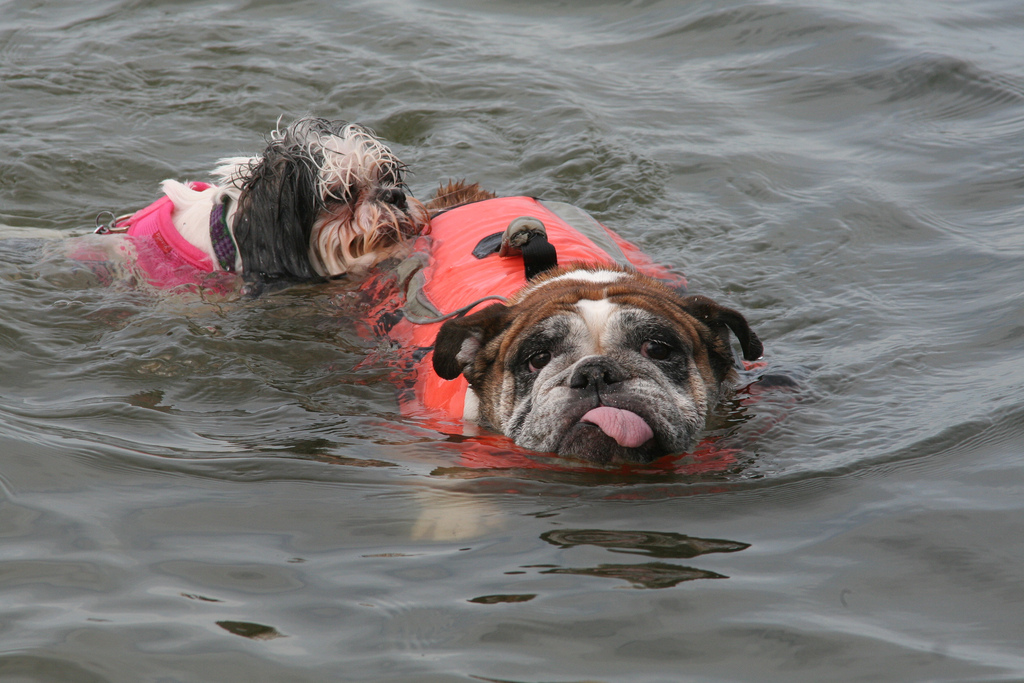
Regardless, I have grown to enjoy swimming, running, and bicycling. It is my goal to complete a "sprint" triathlon this year. I trained for one last summer, but my swimming abilities were just not there yet.
There are other reasons for me to train for this triathlon. Most injuries that I see in my office are due to some sort of over-stress or repetitive stress. The best way to avoid repetitive stress is to vary your exercises. Like I said before, it is easy to stick with what you are good at. Runners want to run. Yogis want to yoga. Meat-heads want to lift weights.
The other reason is for me to complete a triathlon is to learn by experience. Like many things in life, what the books tell you about running, bicycling, and swimming is different from first -hand knowledge. There is still no consensus on many things like the best way to stretch, the best shoes to wear, or the best diet for fuel. Similarly, there are many different theories on what causes training related injuries. How can I expect to know how to treat plantar fasciitis if I cannot avoid getting it myself? Sufficed to say, I have learned much from the journey, and plan on learning much more. Stay tuned.
Monday, April 10, 2017
Wednesday, March 29, 2017
Successful Squatting Part 2
Part 1 of Successful squatting discussed how to save your low back. Part 2 will save your knees. And it's not what you think.
Right now you expect me to say that the knees should never pass over the feet. Hogwash! This is flat out wrong. Almost every trainer in the world has repeated this mantra as if it were Gospel. The truth is that there is a study that says this MIGHT result in knee pain. The same research also suggests that if you limit how far forward your knees move, you are more likely to INJURE YOUR BACK. Pick your poison.
https://pdfs.semanticscholar.org/c375/ff851b69346484952590c2d1185252d7792e.pdf
What you really should be looking out for is how far IN your knees might moving. Many people have tight hip adductors (groin) muscles, and others might have weak gluteus medius and minimus muscles, but proper positioning creates the better balance.
Look at yourself while squatting. It is not hard to see if the knees are collapsing inward, yet is an extremely common mistake. Knee pain is very likely to result. So make sure your shins are as vertical as possible.
If this seems impossible, try the stretch described below. Tight groin muscles might be preventing proper hip positioning, and thus preventing proper knee positioning.
The feet need to be as wide as you can, and and straight forward as you can. Any outward rotation of the feet will result in an ineffective stretch. Then shift your body to one side and hold for 2 seconds, then the other side and hold 2 seconds. Be sure not to hold your breath.
As I stated earlier, I often use the squat as an assessment tool for people with low back, hip or knee pain. Watch yourself in a mirror facing front to check the knees for buckling in. Then turn sideways to check for "bowing". You might be surprised what you find.
Right now you expect me to say that the knees should never pass over the feet. Hogwash! This is flat out wrong. Almost every trainer in the world has repeated this mantra as if it were Gospel. The truth is that there is a study that says this MIGHT result in knee pain. The same research also suggests that if you limit how far forward your knees move, you are more likely to INJURE YOUR BACK. Pick your poison.
https://pdfs.semanticscholar.org/c375/ff851b69346484952590c2d1185252d7792e.pdf
What you really should be looking out for is how far IN your knees might moving. Many people have tight hip adductors (groin) muscles, and others might have weak gluteus medius and minimus muscles, but proper positioning creates the better balance.
Look at yourself while squatting. It is not hard to see if the knees are collapsing inward, yet is an extremely common mistake. Knee pain is very likely to result. So make sure your shins are as vertical as possible.
If this seems impossible, try the stretch described below. Tight groin muscles might be preventing proper hip positioning, and thus preventing proper knee positioning.
The feet need to be as wide as you can, and and straight forward as you can. Any outward rotation of the feet will result in an ineffective stretch. Then shift your body to one side and hold for 2 seconds, then the other side and hold 2 seconds. Be sure not to hold your breath.
As I stated earlier, I often use the squat as an assessment tool for people with low back, hip or knee pain. Watch yourself in a mirror facing front to check the knees for buckling in. Then turn sideways to check for "bowing". You might be surprised what you find.
Monday, March 20, 2017
Successful Squatting
Squatting is not only a great exercise, it is also a great tool with which to measure your overall biomechanics. While many people can be found in gyms squatting in many different ways, we will focus on a basic (back) squat. This is where you put a bar across your shoulders behind your head. Truth be told, most people have such poor form, they should start with their own body weight anyway. However, a broomstick across the back can actually help you start off with the right form.
There are at least 2 very common mistakes made when squatting. One of them is adding a bow at the end of the squat. The squat movement should come from the hips and not the back. This means that the depth of your squat is dependent upon your hamstring flexibility. If your hamstrings are tight, only way to get low is to bow, or to round your lower back, or both. This happens by either the weight shifting forward, and/or with the lumbar spine going into flexion. Either one increases your chances for low back injury.
The best way to overcome these habits is to 1) make sure that your hamstrings are flexible and 2) only go as low as you can without leaning forward or rounding your back. If it so happens that you can only squat down 10 inches with good form, then that is as far as you should go.
Avoid the temptation to stretch the hamstrings by touching your toes. This movement involves rounding of the low back. Teach the body to use the hips by laying on your back and using a strap, cord or jump rope to wrap around the foot, and lift that leg as high as you can while keeping the knee straight. I prefer a two second hold. Repeat 10 times on each leg, and remember to not hold your breath.
The second common squatting mistake will be the topic of the next blog. Stay tuned!
There are at least 2 very common mistakes made when squatting. One of them is adding a bow at the end of the squat. The squat movement should come from the hips and not the back. This means that the depth of your squat is dependent upon your hamstring flexibility. If your hamstrings are tight, only way to get low is to bow, or to round your lower back, or both. This happens by either the weight shifting forward, and/or with the lumbar spine going into flexion. Either one increases your chances for low back injury.
The best way to overcome these habits is to 1) make sure that your hamstrings are flexible and 2) only go as low as you can without leaning forward or rounding your back. If it so happens that you can only squat down 10 inches with good form, then that is as far as you should go.
Avoid the temptation to stretch the hamstrings by touching your toes. This movement involves rounding of the low back. Teach the body to use the hips by laying on your back and using a strap, cord or jump rope to wrap around the foot, and lift that leg as high as you can while keeping the knee straight. I prefer a two second hold. Repeat 10 times on each leg, and remember to not hold your breath.
The second common squatting mistake will be the topic of the next blog. Stay tuned!
Tuesday, January 24, 2017
Exercises to correct anterior pelvic tilt
Sitting is modern man's epidemic. Tight hip flexors are the result of all this sitting, and this starts the dysfunction for many low back pain cases. Anterior pelvic tilt is a common result of this dysfunction. Bridge exercises are usually the go-to for many physical therapists and chiropractors, but often sloppy exercise form dominates. Time is wasted, and low back pain persists. This version of pelvic tilting decreases the chances of incorrect form. "Laying pelvic tilt", "kneeling pocket push", "kneel and lean", and "kneeling bridge" are the exercises covered in the attached video.
Thursday, January 12, 2017
Wall Butt Bump Exercise
This video shows a "wall butt bump" exercise typically given for low back patients. It teaches the body how to bend forward without rounding the low back. When the low back rounds, there is more pressure on the intervertebral discs. When the lumbar spine stays in a neutral arched position, the body utilizes the gluteus maximus muscle to perform the lift. This is biomechanically advantageous since this is the biggest muscle in the human body. Patients are typically instructed to perform 10 reps 3 times per day.
Thursday, December 15, 2016
Floor Exercises for Upper Back and Neck Pain
Here are some of my more commonly prescribed exercises for neck pain, upper back pain, pain near the shoulder blades, and headaches. Exercises shown include the elastic band chin tuck, open book, and cat cow with cat camel variation. The chin tuck is also covered in another video, but this version uses the elastic band for increased resistance. The open book exercise helps with upper back and rib rotational range of motion. The cat cow and cat camel help with range of motion in flexion and extension.
The chin tuck movement helps reduce our tendency to allow our chins to poke forward, the single most common postural fault. The open book movement is often helpful with rib pain and pain near the shoulder blades. It is a motion most of us would just not achieve otherwise. The same is true with cat cow and cat camel, but with the extension motion being needed by most people.
Thursday, December 8, 2016
Chin tuck exercise laying on back
Good posture is a funny thing. Most people are pretty sure that they slouch, others feel that they are at least trying. The only people I see in my practice with good posture is people who have dance experience, usually ballet. I should note that not all dancers have good posture, but what they do have is good body control. The best yogis have good posture as well, but that is usually if it is their full time job. If I ask an average Joe or Jane what good posture is, the result is often ridiculous. But it is not really their fault, no one has shown them otherwise.
The biggest common denominator is the chin. Yes, the chin. it sticks out forward too much. The reason is obvious: people are often in occupations that demand that they sit and work on a computer, or sit and drive, or just plain sit. And now we have smart phones. One more reason to lurch into a forward head position for hours on end. Between computers, tablets, and smart phones, chiropractors will be in business for a very long time. So whats to be done about it?
The single best exercise that you can do is the chin tuck. But it is not as easy as it sounds. A visual description is best, so here is a video with the chin tuck exercise and some variations on it. The important thing to note is that the chin comes in and the base of the skull goes backward. The net result is no tilting forward, and no tilting backward. The best results are achieved if you can start the movement by contracting the abs. No big crunch or sit-up is needed, just a simple ab tightening. Timing this with your breath is important as well. Forced exhalation activates the core abdominal muscles, so I use this trick to our advantage. Another reason is that I know my patients, and the tendency for one to hold their breath is very common. So common, in fact, I would expect it to happen if I said nothing about it. The simple act of tightening one's abdominal muscles and continuing to breathe is actually very difficult for many. Add the chin tuck on top of that is even harder. The effort is definitely worth it, because if you cannot perform this exercise, you cannot have good posture.
Subscribe to:
Posts (Atom)


